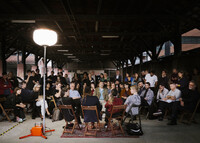
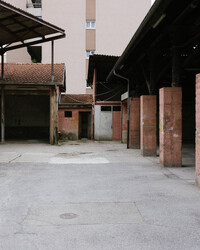
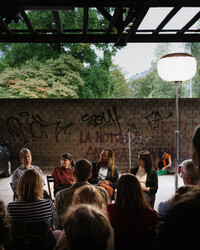
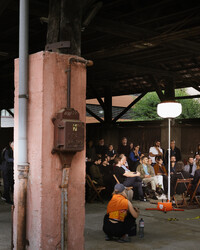
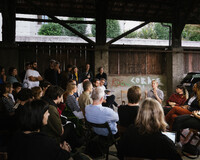
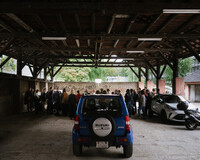
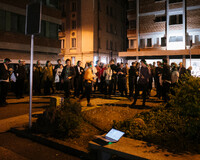
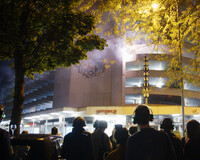
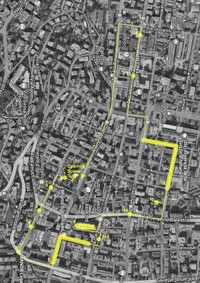
Territorial Shift ist eine Serie von ortsspezifischen Arbeite für die Biennale Del Territorio in Lugano. Ein zum Abbruch freigegebenes Areal wird zum temporären Veranstaltungsort: Der Roundtable "Care" der Biennale Del Territorio wird in den ehemaligen Werkhof der Stadt Lugano entführt, der mit einfachen, atmosphärischen Interventionen und einer fünfminütigen Intensivreinigung zum Veranstaltungsort wird. Ein Audiowalk durch Lugano überlagert filmische Zitate, Architekturtheorie und den erlebten Ort: Das Alltägliche wird neu gesehen, Potenziale werden sichtbar und Räume durch die Verschiebung der Wahrnehmung aktiviert.
Screenplay:
Scene 1:
From the moment we – and all of you – can access or share a territory, we belong to that territory. And that territory becomes urban. Territorial Shift expands the perimeter of the Biennale into the city and takes you on a trip exploring urban potentials of Lugano. Through alternative narratives and the power of imagination we create a new territory - a fantastic elsewhere.
Scene 2.
Immanuel Kant postulates that knowledge has its origin in two basic components: intuition and thought. According to Kant all our thinking is related to imagination, which means it is related to our senses, because the only way to describe an object is through imagination. The intellect is incapable of perceiving anything, and the senses cannot think. Only through a combination of both can knowledge arise. Imagination has to precede all thinking processes since it is nothing less than a synopsis, an overall ordering principle bringing order into diversity. If we accept that thinking is an imaginative process of a higher order, then it means all sciences are based on imagination.
Scene 3.
The distinction of inside vs outside can now be employed as the crux in the formal definition of the concept of territory: a territory is an entity that distinguishes and thus establishes an inside (its inside) as distinct from an outside (its outside). That suffices. Every communication is dialogical. Every communication offers itself, or is exposed to, the binary choice of being accepted or rejected.
Scene 4.
The quality of a building depends precisely on the fact that it has not one predetermined use but several; it depends on the fact that multiple use is possible, that the rooms are versatile to some extent, because – I am thinking now of the urban planning context – versatility alone facilitates that which makes a city what it is, namely the overlap of different uses.
Scene 5.
Only the overlap gives rise to the urban interweave, gives rise to that which makes the city what it is, namely the market-like interweave of extremely diverse forms of use.
Scene 6.
The situation construite, the “constructed situation”, is best thought of as a Gesamtkunstwerk (a total work of art). Each constructed situation would provide a décor and ambiance of such power that it would stimulate new sorts of behavior, a glimpse into an improved future social life based upon human encounter and play.
Scene 7.
Un vero prato arriva fino al centro della terra!
Scene 8.
Architecture must advance by taking emotionally moving situations, rather than emotionally moving forms, as the material it works with. And the experiments conducted with this material will lead to unknown forms
Scene 9.
L’acquedotto vive al momento che ha cessato di portare l’acqua!
Scene 10.
Early skateboarders in the 1960s were commonly surfers, and used skateboards when the surf was flat. The urban modernism allows frustrated surfers to re-enact the sense of being on the sea, rolling down tarmac as if it were an ocean wave. In spatial-architectural terms, the modernist space of a city was appropriated and re-conceived as another kind of space, as a concrete wave; second nature was returned to first nature.
Scene 11, 12, 13.
If there is to be a “new urbanism” it will not be based on the twin fantasies of order and omnipotence; it will be the staging of uncertainty; it will no longer be concerned with the arrangement of more or less permanent objects but with the irrigation of territories with potential; it will no longer aim for stable configurations but for the creation of enabling fields that accommodate processes that refuse to be crystallized into definitve form; it will no longer be about meticulous definition, the imposition of limits, but about the expanding notions, denying boundaries, not about separating and identifying entities, but about discovering unnameable hybrids; it will no longer be obsessed with the city but with the manipulation of infrastructure for endless intensifications and diversifications, shortcuts and redistributions – the reinvention of psychological space. Since the urban is now pervasive, urbanism will never again be about the “new”, only about the “more” and the “modified”. It will not be about the civilized, but about underdevelopment. Since it is out of control, the urban is about to become a major vector of imagination.
Scene 14.
We accept what exists.
We were making sand castles. Now we swim in the sea that swept them away. What if we simply declare that there is no crisis – redefine our relationship with the city not as makers but as its mere subjects, as its supporters?
More than ever, the city is all we have.
Die i2A Biennale Del Territorio 2023 (non)finito wurde kuratiert von Ludovica Molo + Marc Frochaux
Intervention: Stefan Wülser + Céline Bessire + Matthias Winter
Roundtable: Charlotte Malterre-Barthes, Kathrin Dörfler, Anna MacIver-Ek, Monica Rhodes