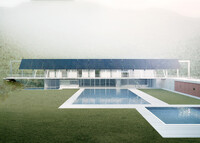
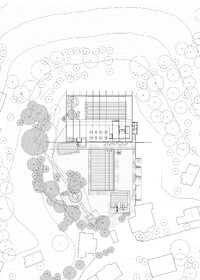
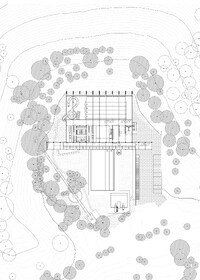
The current state of the Sonnenberg Pool offers only a faint glimpse of how Beda Hefti balanced the relationship between grand gestures and subtle engagement with the landscape. The distinctive feature of his design for Engelberg was the dramatic slope of the site and the resulting conflicts with Hefti’s two-dimensional organizational logic and vertically structured formal language. As if he did not want to commit himself entirely, the pool appears in historical images to be half buried in the ground and half rising from it; it respects the landscape only as much as necessary and appropriates it with ease when it serves the built space. Not only has the facility itself been altered over time, but the surroundings of the pools have also changed. Where spacious, precise paving once contrasted with the open hillside meadows, the two have now converged: The surroundings are characterized on both sides by single-family homes, and the pools, likely due to pressure from usage and changing functional requirements, is structured in a much more fragmented and piecemeal manner—as if it itself wanted to be part of the “little houses and gardens.” This change in the built outdoor space forms the starting point and scale for our project. We seek an architecture that stands out from the domesticated character of the houses, without, however, making claims to grandeur and representation, as the hotel buildings in Engelberg do. The project seeks to belong to the landscape, to the steep slope above us, and to the mountains in the near distance.
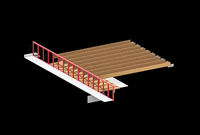
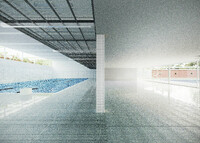
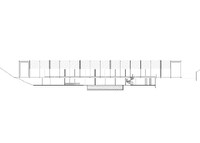
Understanding the Sonnenberg Pool not as a building opens up a whole range of possibilities. We utilize the topographical arena and the changes in elevation between the arrival point and the sunbathing lawn to arrange the ticket booths, changing rooms, and all other functional spaces along a linear bridge. This allows the outdoor and indoor pools to be organized with the same entrance, the same ticket booth, and the same changing room area, without the need for disruptively long or atmospherically inappropriate pathways. By extending the bridge to serve as an intermediate climate zone (a legal basis analogous to seasonal rooms), we avoid any loss of comfort in winter and, in summer—with the vertical sliding windows open—reach the changing rooms accompanied by the cool mountain breeze. This adaptability and flexibility distinguishes summer swimming, relaxation, and the pleasant, nature-oriented lifestyle in the sun from winter sports activities. The primary elements of the facility—the Vierendeel truss supporting the bridge, the retaining wall beneath the arrival area, and the new, iconic slide—restore the facility’s generous scale. While the individual components convey a sense of spaciousness with as few material transitions and breaks as possible, the architecture as a whole dissolves into performative individual parts and becomes light. Whereas symbolism and motifs were central to Beda Hefti’s design, today it is the optimized, flexible, and sustainable structure that defines its distinctive character. As infrastructure, the project celebrates the performative mixed construction approach, the composite and the pragmatic.
Competition entry
Architecture: Stefan Wülser + Moritz Wahl
Landscape: Andreas Klein