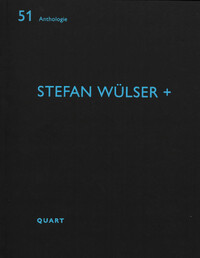
Stefan Wülser’s architecture can be described as “flat”. This is not in the sense of lacking depth, but is meant ontologically, in the sense of what the elements of the designs and buildings depict, and even more in the sense of what they are, that is, that they are themselves; elements, objects with intrinsic value, and thus of equal importance, equally valuable. This form of valuation requires an explanation. It begins with the design process, not with the objects that are finally put out into the world. Sometimes it takes a while before a sketch or concept can be recognised. Investing more in thinking as in drawings or building materials does not mean that the material is undervalued, rather all aspects of a design problem, all its conditions and capabilities, receive the same attention and meaning through the process of seeing and considering. This also implies that the contradictions of the world in which design takes place are not immediately resolved but remain in limbo. With time, sometimes more quickly, sometimes more slowly, “islands of resolution” begin to crystallise from this assemblage, approaches for working on one problem or another.
Designing then takes place in and between the things. This also needs to be explained. Because the contradictions of the world call out to us humans for "islands" of order, as Wülser's work progresses, objects emerge that refer both to the problem and, through the means of architecture (colour, material, assembly), strongly refer to themselves, acquiring intrinsic value. Much is reminiscent of the designs of the Russian avant-garde of the 1920s: construction, Proun, Architekton... much of which appears to be one object assembled to another, brought together in time, colliding, dissolving again. Between the objects, something "happens". It would be wrong, however, to call them collages. The objects are mediated, they influence each other, change each other, becoming associations, new entities – themselves part of other entities. They create spatiality, or more specifically, clouds of matter, habitable spaces, zones. The act of construction becomes clearest in the axonometric drawings: existing, added, mineral, technical and vegetal overlap, superimpose, are braced, nested, shaded and provide shade – three-dimensional, with depth, and flat.
Tibor Joanelly, "Act of Construction"
The anthology series has been published by Heinz Wirz at Quart Verlag since 2004 as a curated selection of young Swiss architecture practices.
> Buy at Hochparterre
Texts: Stefan Wülser + Tibor Joanelly + Christoph Ramsch
Translations: Nicholas Elliott
Design: Stefan Wülser + Quart Verlag